Reducing non-quality costs to improve performance and profitability
To better satisfy your customers and boost your company’s profitability, it is essential to address the costs of poor quality. These costs encompass all forms of waste resulting from errors, rework, scrap, breakdowns, delays, or customer dissatisfaction, which can have a direct impact on your revenue, margins, and brand image.
The Lean approach aims to eliminate anything that does not add value for the customer, by focusing on process optimization and defect prevention. By doing so, you not only reduce costs associated with poor quality, but you also improve customer satisfaction, the smooth flow of your operations, and the overall efficiency of your teams.
The Cubik teams are here to support you through the following following
Reducing Waste (muda)
Identify and eliminate the 8 types of waste (defects, overproduction, unnecessary inventory, unnecessary movement, waiting, transportation, unnecessary operations, and waste of talent).
Fewer defects = fewer rework, delays, and associated costs.
Process Standardization
Clear, shared methods reduce human error.
Standards facilitate monitoring and training.
Quality at the Source (jidoka)
Detect problems as soon as they arise and prevent them from spreading throughout the value chain.
Example: Shutting down the line in the event of a defect, rather than correcting it later.
Continuous Improvement (kaizen)
Engage teams to identify and resolve the root causes of problems.
Small, repeated improvements = gradual reduction in non-quality costs.
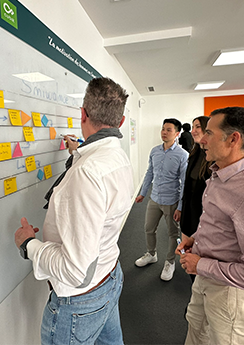
Visual Tools and Visual Performance Management (MVP)
Facilitate the detection of anomalies through simple, visible indicators that are monitored in real time.
Respond quickly before costs pile up.
Total Productive Maintenance (TPM)
Reduce breakdowns and unplanned downtime, which often lead to quality issues.
Reliable machines = stable processes.
Listening to the Customer (VOC)
Understanding actual expectations helps avoid over-engineering (which is also a waste).
Focus on what truly adds value.
Practical application:
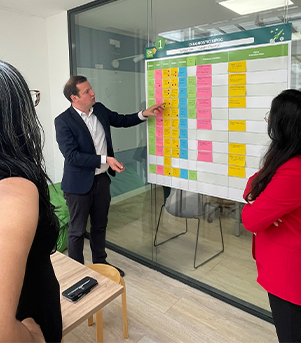
In practical terms, Cubik helps your teams implement simple and effective methods to solve problems quickly and sustainably:
-
Immediate Action Sheet: Short-cycle resolution to correct issues as they arise.
-
A3 Problem Solving & Quality Assurance: A longer-cycle problem-solving approach to address root causes and achieve sustainable improvements in your processes.
With these tools and the support of our experts, your teams will become self-sufficient in defect prevention, controlling non-quality costs, and continuous improvement, while fostering a culture of excellence and sustainable performance.