
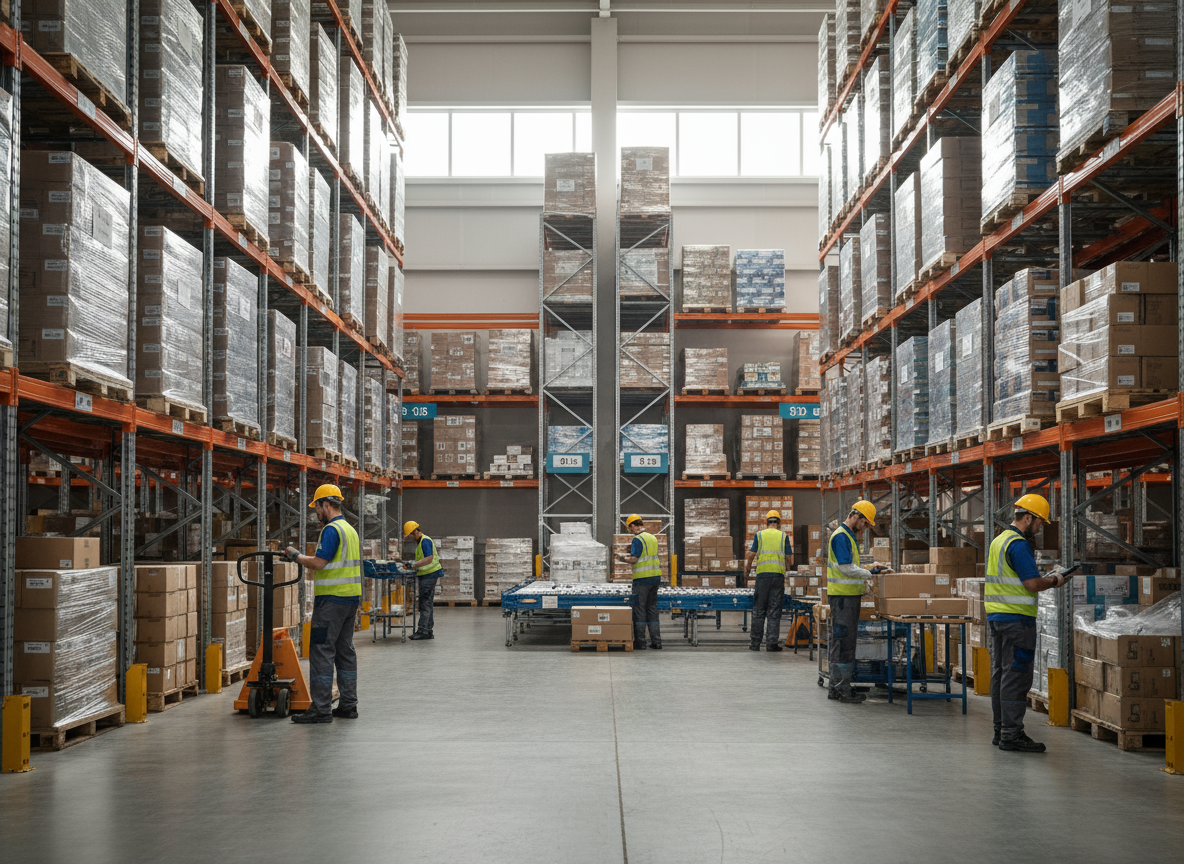

100% participation in briefings to foster a shared culture of logistics performance.

USE CASES
Reorganization of logistics flows in a warehouse for an agricultural cooperative.
Project Objectives
Training for the various stakeholders:
- Raising Awareness Among the Executive Committee.
- Practical Training for Front-Line Managers: Training on Issues They Face in Their Daily Work.
Fieldwork:
- Implementation of Visual Management to support day-to-day warehouse operations.
- Implementation of standards and procedures for problem-solving (improving delivery routes for drivers, correcting picking locations, and increasing truck fill rates, etc.).
The Approach
- Develop a sustainable approach to managerial transformation.
- Improve process efficiency and reduce the number of errors during preparation.
- Create a showcase for the group’s continuous improvement project.
- 1 Executive Committee to be briefed.
- 6 operational managers and their teams to be mobilized across various logistics functions.
The results obtained
- Elimination of the number of defects (example: failure to load pallets).
- Improved working conditions (reduced commute time).
- Streamlining processes (Reducing handling times).
- 100% attendance rate at briefings.
- “We meet up there in the warehouses.”
- “Best practices are best shared.”