
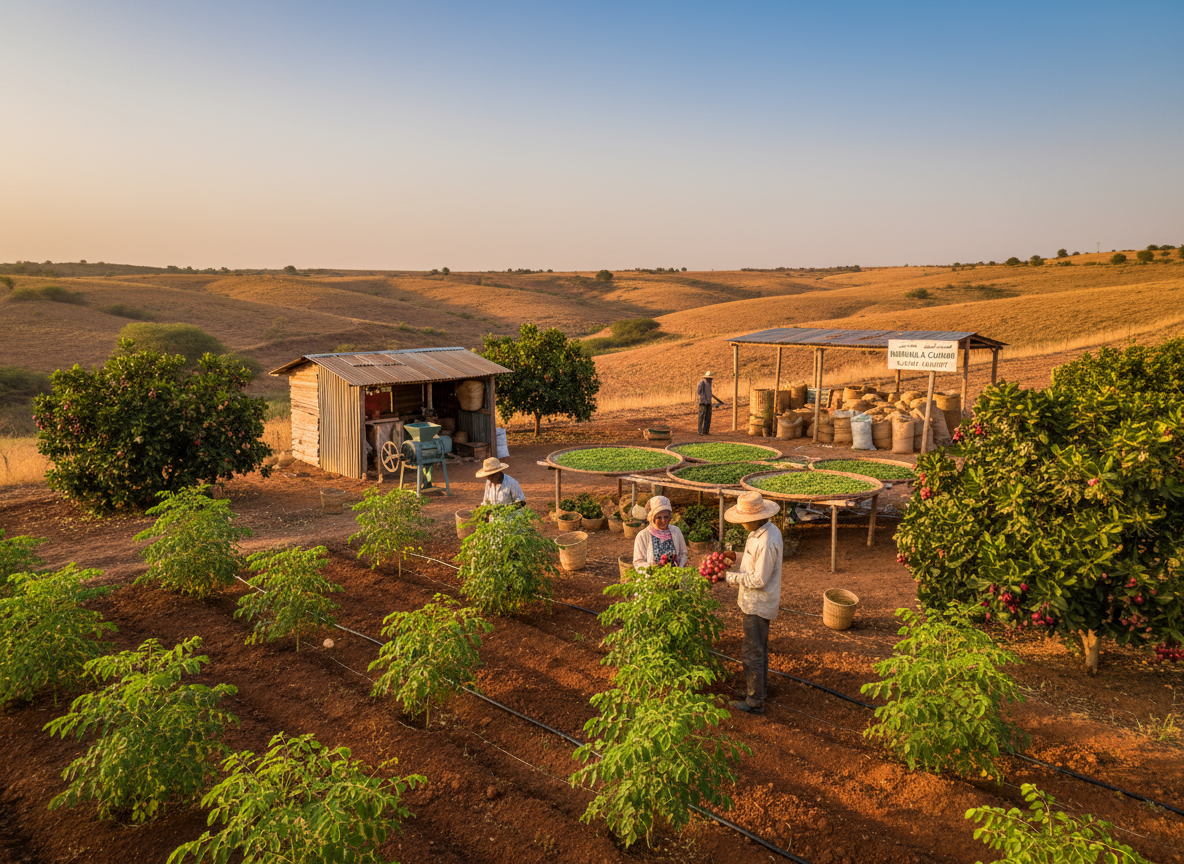

Turning climate challenges into economic opportunities through high-value-added crops.

EXPERTISE
High-Value-Added Crops: When Agriculture in Arid Regions Creates Value!
In the arid and semi-arid regions of sub-Saharan Africa and the Middle East, characterized by water scarcity and significant climate stress, certain agricultural crops stand out for their ability to become true economic drivers. They are referred to as high-value-added crops, as they combine adaptation to harsh conditions, commercial potential in international markets, and the ability to generate sustainable income through processing and diversification of uses. Several plants, such asaloe vera and certain spices, could illustrate this trend. Two crops have caught our attention: moringa and cashews.
Significant potential for industrialization and diversification:
These examples show that the true value of these crops lies not only in their ability to grow in challenging environments, but above all in their potential for industrialization and diversification. Focusing on such crops means investing in agriculture that goes beyond mere survival to become a driver of economic and food sovereignty. At a time when global demand is shifting toward natural, sustainable, and traceable products, these high-value-added crops offer producing countries a rare opportunity to combine ecological resilience with economic prosperity.
High-value crops: examples include cashews and moringa.
Moringa and cashews, although very different, share strong similarities when it comes to wealth creation. Both have found their place in dynamic global markets, driven by favorable consumer trends: the search for superfoods in the case of moringa, and the growing popularity of dried fruits in the case of cashews. In both cases, the added value lies not so much in raw production as in processing and marketing.
Dried and powdered moringa leaves are exported to specialized nutrition and wellness markets, while its seeds yield a high-quality oil that is highly sought after in the cosmetics industry. Cashews follow a similar trajectory: while Africa currently produces more than half of the world's cashew production, the majority of the profits still elude local producers, as processing takes place in Asia before re-export. However, the development of local processing facilities—whether for grinding and packaging moringa or for shelling and roasting cashews—paves the way for greater capture of economic value.
These activities create jobs, and revitalize rural economies , and create export opportunities with higher margins, while gradually integrating producers into international value chains.
A development challenge for local economies.
Beyond international markets, the added value of these crops also plays a role in local economies. The development of processing sectors creates a network of non-agricultural jobs, particularly for women and young people, who are often marginalized in rural areas. A moringa processing facility can generate several dozen direct jobs and just as many indirect jobs in harvesting, packaging, or logistics. Cashew nut shelling plants, for their part, employ a large workforce and help structure entire rural areas around new economic hubs. These multiplier effects strengthen regional resilience, diversify sources of income, and contribute to reducing rural poverty.
Through our partnership with Les Domaines Agricoles, our team supports high-value-added crop projects in arid and semi-arid regions, with the goal of turning these local crops into drivers of economic development that benefit the entire local ecosystem.