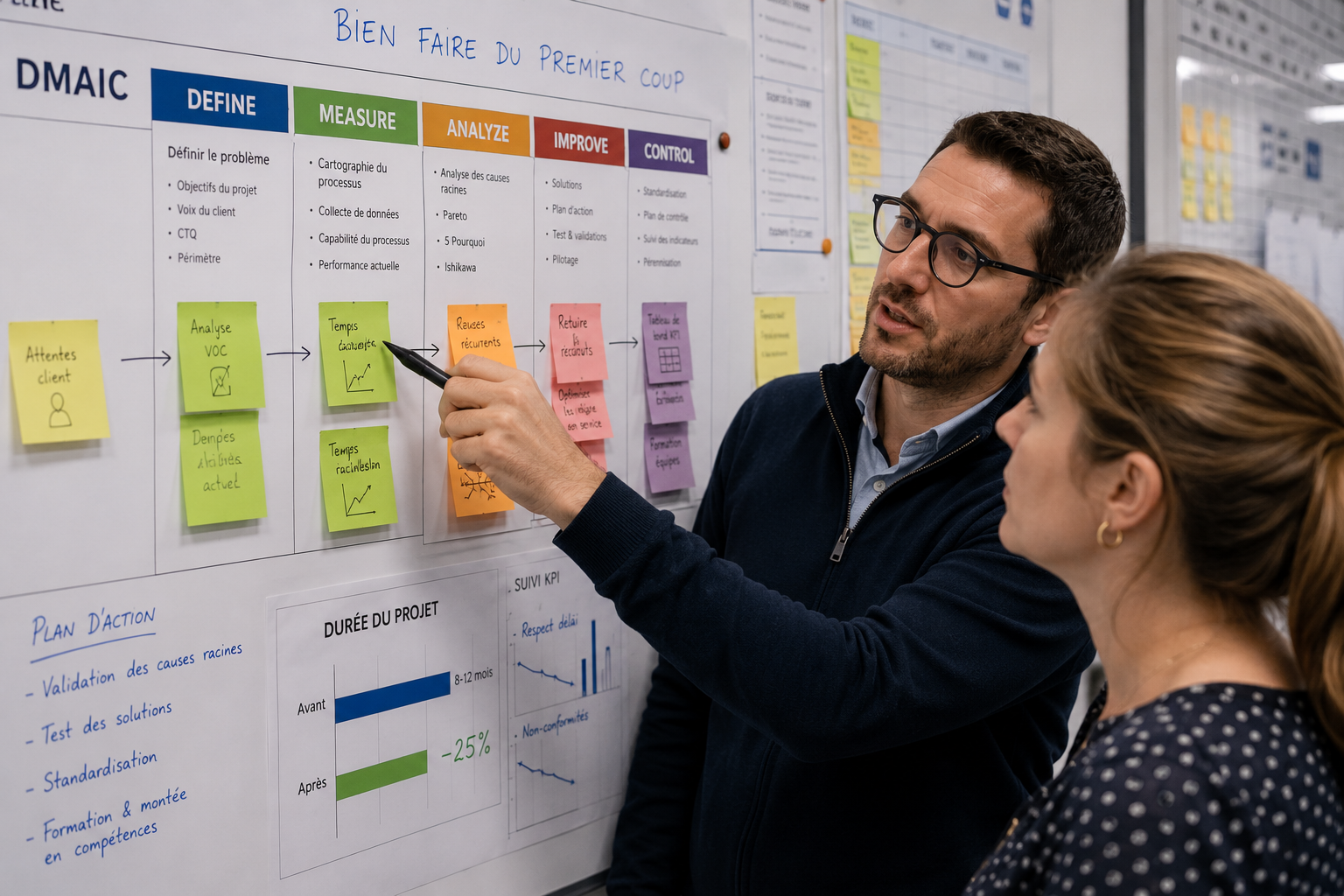

A 25% reduction in project duration, while strengthening the autonomy and legitimacy of the Green Belts.

USE CASES
Support teams in ensuring that installation projects are successful on the first try and strengthen their skills in continuous improvement.
In many regions, completing construction projects on time and by the scheduled date remains a recurring challenge. Delays affect not only customers but also internal teams and overall planning, creating a cycle of frustration that can last for years. It was therefore essential to find a local solution before considering it as a national model.
To address this challenge, targeted support was provided to two Green Belts (GBs) with experience in project management and continuous improvement who were leading a major project. The goal was twofold: to ensure the project’s success and to strengthen the GBs’ skills and credibility in the field.
Project Objectives
The project was considered a success if:
-
The Green Belts’ legitimacy and credibility were strengthened.
-
The use of continuous improvement tools and cultural messages fostered a new and effective approach.
-
The project adhered to the standard six-month timeline, despite its actual scope, which could have taken eight to twelve months.
The Approach
1 – Demystifying Improvement Tools
-
Translate training theory into concrete, actionable tools tailored to the company’s specific context and strong corporate culture.
-
Guide, suggest, and challenge the planning of improvement workshops, taking a step back to develop proactive content tailored to their objectives.
-
Take prompt action to resolve any initial issues identified in real time.
2 – Going the Extra Mile in Support
-
Supplement the program with additional tools or by drawing on specific expertise to organize a seminar on continuous improvement projects involving 30 sites and 15 working groups.
-
Help structure the project’s governance, which is divided into five lots, forms part of a broader national program, and is closely monitored by management.
Feedback from Participants
Feedback from Green Belt participants highlighted several key benefits:
-
Each discussion helped raise awareness and made it easier to grasp complex concepts—some of which were less familiar or had been overlooked during the training.
-
The remote format proved to be effective, even though an in-person session would have been appreciated.
-
The coaching was tailored to the realities on the ground, featuring active listening and discreet yet relevant interventions to help workshops move forward.
-
The coach’s responsiveness was unanimously praised: quick responses, concrete examples, and helpful feedback.
The results obtained
Thanks to this support, the project has achieved several significant results:
-
Relief and revitalization of the Green Belts, with strong mobilization.
-
Reduction of the project duration by 25%.
-
Channeling early-stage initiatives toward truly relevant solutions, following an analysis of the problems.
-
Greater team engagement, including in leading workshops that were initially perceived as time-consuming.
-
Successful organization of a seminar attended by more than 100 participants.
-
Development of a two-year roadmap and an internal Lean awareness module.