
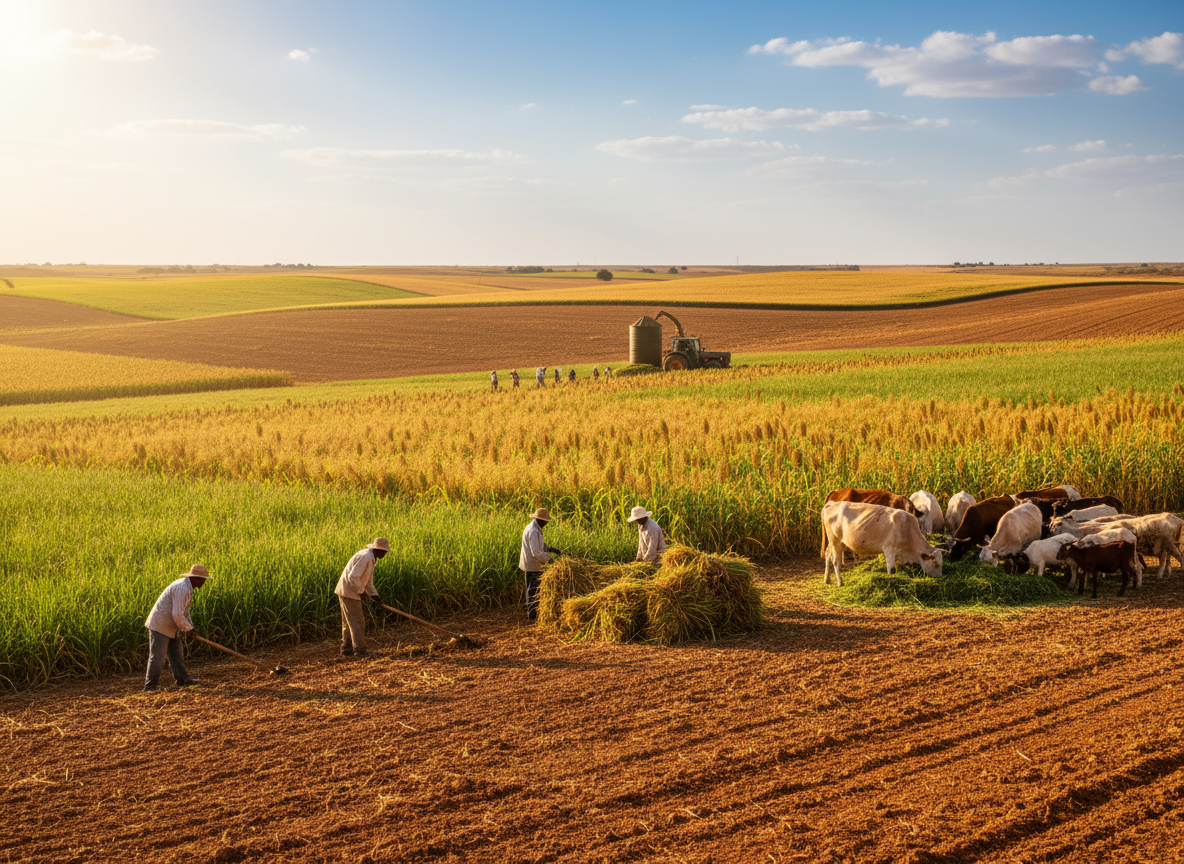

Forage self-sufficiency: A key factor in the resilience of livestock operations in regions experiencing water stress.

EXPERTISE
A market hungry for innovation!
Forage forms the basis of the diet for ruminants in most livestock systems. It refers to all crops or plant resources intended for consumption by animals, whether grazed, mowed, or preserved. In highly intensive farming areas, forage corn plays a central role: harvested whole and then ensiled, it is a major energy source for herds, particularly in dairy systems. However, in the arid and semi-arid regions of Africa and the Middle East, production conditions are becoming increasingly challenging, compromising both the available quantities and quality.
Water stress: increasingly challenging production conditions.
On the ground, reports are mounting: farmers are struggling to maintain their forage corn acreage, yields are falling, and the quality of the silage is often poor. The crops are too wet, poorly stored, or grown from varieties ill-suited to local conditions. As a result: herds are consuming forage of low nutritional value, which directly affects animal performance, particularly milk production. In some areas, livestock producers must compensate by purchasing expensive concentrates, which further weakens livestock production systems.
The surge in imports.
In the absence of a local solution, imports are skyrocketing. Thousands of metric tons of hay, dehydrated alfalfa, or corn silage are purchased each year on international markets, primarily from Europe and the United States. This massive reliance on imports poses a fundamental problem: importing forage means importing water, with all the logistical and environmental costs that entails. This strategy is neither sustainable nor coherent in a context of scarce natural resources and rising geopolitical uncertainties. Indeed, production requires significant volumes of water. For example, producing one metric ton of alfalfa consumes between 400 and 600 m³ of water. By importing these forages, we are therefore shifting the pressure on water resources to other countries, rather than producing locally—which makes little sense for regions that are themselves experiencing water stress.
In Morocco, water availability is a strategic issue.
Morocco is often cited as a model for forage development in Africa. Irrigated areas there contribute significantly to national dairy production, and agricultural policies have long encouraged corn cultivation and the genetic improvement of livestock. But this image masks deep-seated vulnerabilities. Yields are stagnating, production costs are skyrocketing, and access to water is becoming critical, particularly in the Sebou River basin. Farmers are reducing their forage crop rotations in favor of more profitable or less resource-intensive crops. The situation is such that Les Domaines Agricoles itself is considering sourcing feed from Mauritania to ensure the continuity of its livestock operations. At the same time, a national forage plan is being developed, a sign that the issue is now considered a strategic priority.
Reexamine the issue of animal feed using a more realistic approach.
Throughout the arid and semi-arid regions of the world, the issue of forage self-sufficiency is becoming a central concern. It would be a mistake to try at all costs to replicate an intensive, corn-based model that is unsuitable for many areas. Instead , we should encourage diversification using more resilient species:
- Forage sorghum, for example, is highly drought-tolerant and offers good potential for utilization, whether as pasture or silage.
- Varieties such as sudangrass or bicolor hybrids are showing promising results.
- Fodder beets, a concentrated source of winter energy, can also play a role.
- Cereal and legume blends offer both high yield and nutritional value.
It is becoming urgent to revisit the issue of forage production with a more realistic approach, tailored to local agroclimatic conditions and the socioeconomic constraints faced by livestock producers. It is not just a matter of producing volume, but of producing high-quality forage through sound production practices, sustainable resource management, and more self-sufficient systems. Against a backdrop of climate change, population pressure, and tensions in global agricultural markets, forage is no longer a variable to be adjusted: it is a strategic resource that must be secured to ensure the resilience of livestock operations and the future of the animal production sectors.