

Free up time for healthcare providers so they can focus on what matters most: the patient.

EXPERTISE
What if Lean could finally free up time for hospital staff?
In many healthcare facilities, day after day brings the same reality: teams are short on time, tasks pile up, information doesn’t flow smoothly, and certain equipment always seems to be “in the wrong place at the wrong time.” These very real challenges take a toll on both the quality of care and the well-being of healthcare professionals.
What if a structured approach could simplify day-to-day operations, reduce irritants, and—above all—free up time for what really matters: the patients?
That is precisely the promise of Lean when applied to the healthcare sector.
Understanding Lean in a Hospital Setting
When applied to the healthcare sector, Lean becomes an approach to continuous improvement focused on two key areas: value for the patient and the quality of life for healthcare teams at work.
The goal is not to “do more with less,” but to eliminate what hinders work: unnecessary repetitive tasks, waiting times, searching for supplies, communication errors, excessive travel…
Here are a few concrete examples:
-
Hard-to-find equipment: We’re reworking storage, workflow, and equipment availability.
-
Procedures that are vague or vary from team to team: we work together to develop clear standards tailored to the field.
-
Constant back-and-forth: We’re rethinking the spaces and the distribution of activities.
-
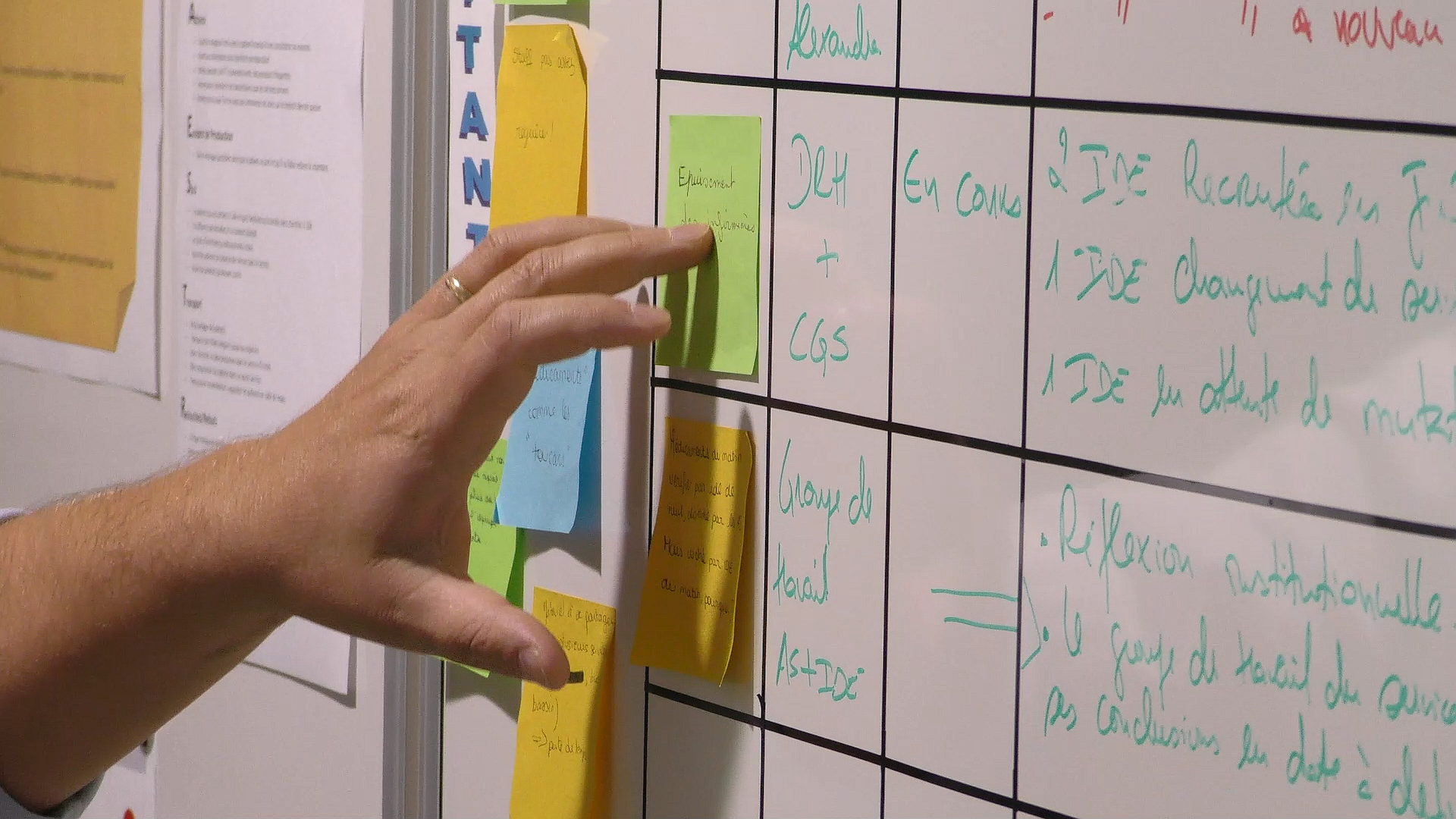
Information that gets lost along the way: we’re implementing simple and reliable visual tools.
The approach is based on on-the-ground observation (Gemba) and the active participation of professionals, since they are the ones who best understand the realities of the service. Lean does not impose a one-size-fits-all solution: it builds a tailored response that originates from the front lines and is tested and refined as a team.
The Practical Impact in Hospitals
Organizations that have adopted a Sustainable Lean approach are seeing visible and lasting improvements, including:
-
A reduction in the time spent on low-value-added tasks.
-
Fewer errors and less stress caused by organizational problems.
-
Smoother care pathways and better coordination among healthcare professionals.
-
Greater involvement by the teams, who are taking an active role in driving changes to the service.
-
More time for patients, thanks to a simpler daily routine.
Contrary to popular belief, Lean is not an additional burden. On the contrary, it is a tool that helps you regain control of your organization, streamline work, and reduce pressure on teams. The results are quickly evident: less waste, greater peace of mind, a more cohesive work environment, and improved patient care.
Often, it all starts very simply: a small idea, a first attempt, an experiment in one department… and then, little by little, a collective momentum begins to take shape.