
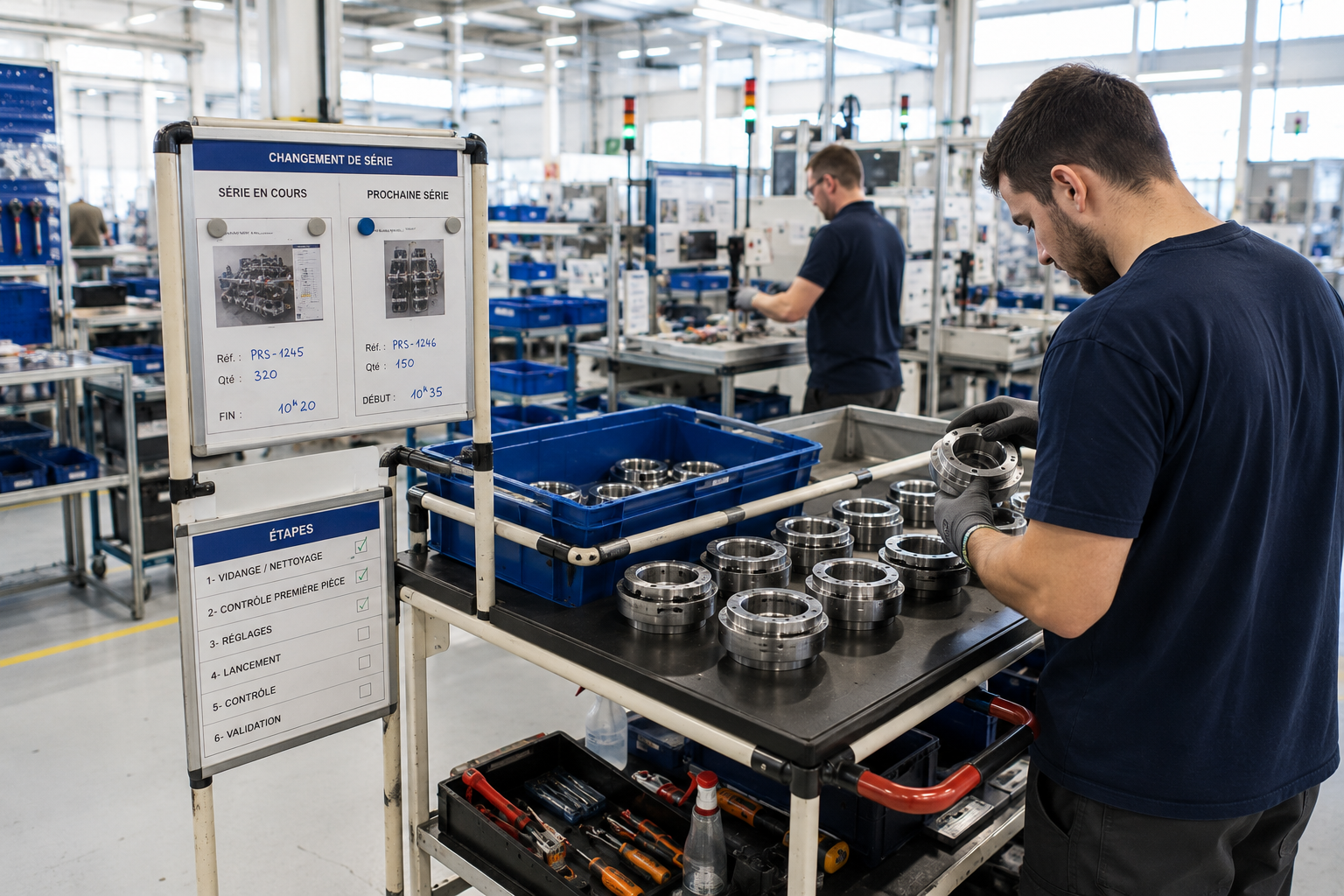

A 55% reduction in changeover times, generating an additional 730 k€ in profit.

USE CASES
Reducing changeover times to increase capacity and margins: a successful SMED project.
In many industries, managing production lines is a daily challenge. Teams must respond to fluctuating orders while adhering to capacity and deadline constraints. This was the case for one production line, which had to process an average of 90 metric tons of orders per week with an initial capacity of 70 metric tons. To meet this demand without overburdening the teams, the goal was clear: reduce changeover times.
The SMED Approach: Saving Time Without Working Faster
To meet this challenge, a SMED (Single Minute Exchange of Die) process was implemented. The approach aimed to simplify the teams’ daily work and make changeovers faster and smoother, without increasing pressure or the pace of work.
1. Train and raise awareness among teams
The first step consisted of training in SMED methods combined with on-the-job tours. The goal was to familiarize employees with the principles of reducing changeover times and to directly involve them in identifying bottlenecks and opportunities for improvement.
2. Build the construction site control area
To organize the project and ensure effective monitoring, a dedicated control center has been established. This center centralizes information, allows for tracking the progress of activities, and facilitates communication among the various stakeholders.
3. Implement the SMED method and plan the necessary actions
The project was organized into two parts:
-
Quick actions: those that could be implemented immediately to reduce changeover times.
- Medium-term actions: identified and tracked through A3 project reports, ensuring sustainable and measurable improvement.
4. Ensure the results are sustainable
To ensure the initiative’s long-term success, a training phase was conducted to institutionalize SMED. This included developing standards, conducting regular audits, and implementing the Minimum Viable Process (MVP), so that every changeover would follow a proven and reproducible method.
Objectives and Results
The initial goal was ambitious but clear: to reduce changeover time by 33% by simplifying tasks and eliminating activities that do not add value.
The results exceeded expectations:
-
Actual reduction in changeover time: 55%
-
Direct financial gain: €730,000 in additional profit
These results show that improvement is not measured solely in terms of speed, but above all in terms of efficiency, standardization, and process simplification. The teams were able to work more smoothly, securely, and calmly, while significantly increasing the line’s capacity.
Key Takeaways
-
The involvement of teams on the ground is essential: that’s where the best ideas for simplifying work and eliminating wasted time come from.
-
Structure and follow-up are essential: the steering committee and the A3 project sheets help turn one-off initiatives into lasting results.
-
Standardization for sustainability: training, audits, and standards ensure that gains are not lost over time.
This SMED project perfectly illustrates how a structured, participatory, and incremental approach can transform a production line, increase capacity, ensure operational safety, and generate tangible financial results.