
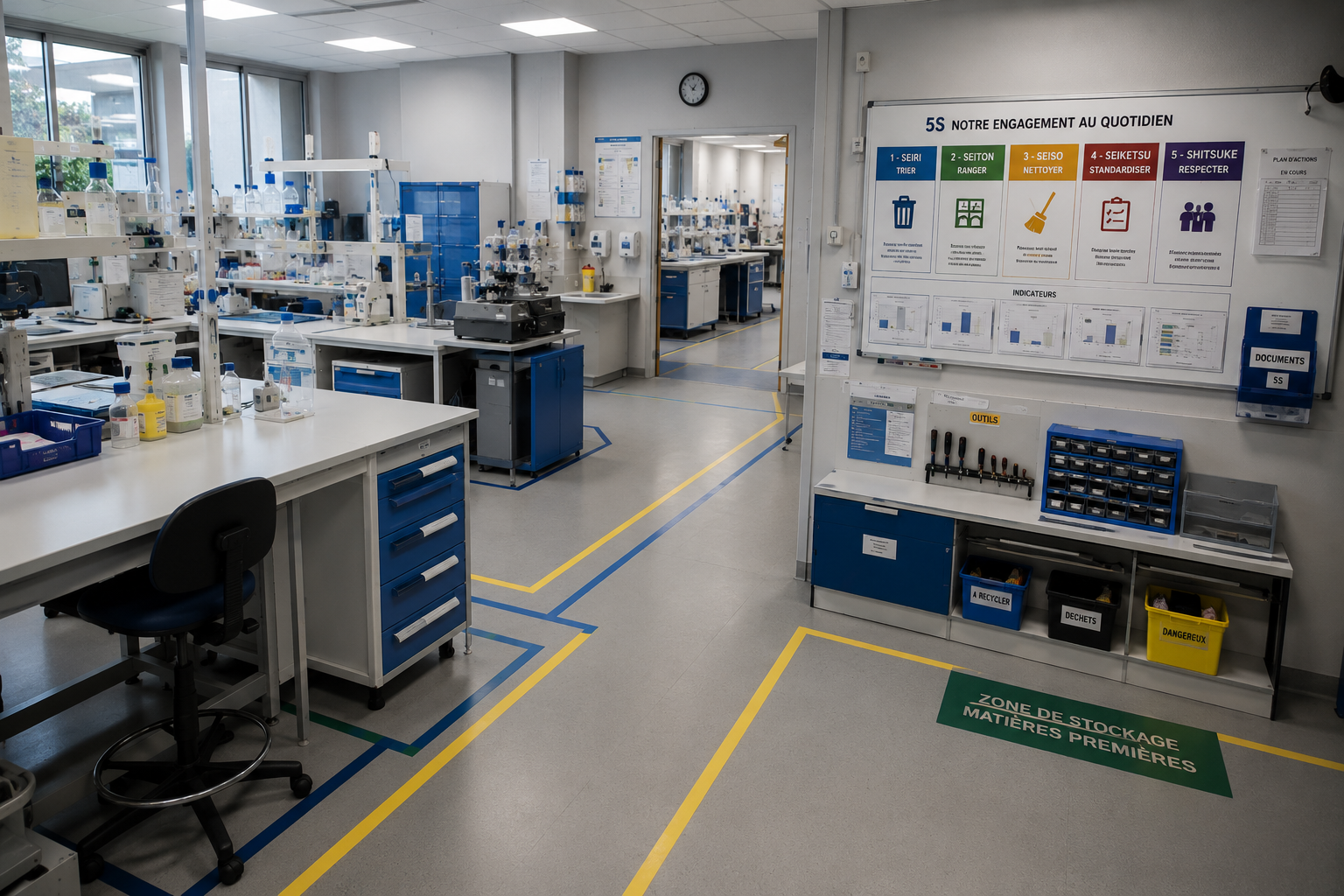

10 to 15% of space freed up and a search time of less than 3 minutes.

USE CASES
Lay the groundwork for a visual, standardized, and collaborative organization.
As part of its preparations for a future operating model that is closer to production than to testing, a laboratory has launched a 5S initiative to gradually adopt the principles that will shape the new model: teamwork, visualization, standardization, and collective performance. The goal: to create, starting today, an environment capable of supporting higher throughput, more shared spaces, and enhanced coordination across departments.
Project Objectives
Although the laboratory’s operations have not yet changed, upcoming requirements make it necessary to plan ahead. Teams will need to transition to a more visual, more standardized organization where information sharing becomes second nature. The 5S method has emerged as the primary tool for initiating this cultural transformation by preparing workspaces, routines, and behaviors aligned with the future way of working.
The success was based on two major goals:
- To firmly establish 5S practices within all teams.
- Be able to apply the 5S method even in areas that are subject to change, using simple, robust, and adaptable methods.
The approach taken in the laboratory
1 – Acculturation of the Mind
The teams explored the following principles: shared space, optimizing workflows, team-based management, accountability, and active contribution to the project. The 5S method became the practical way to put this new way of working into practice.
2 – Phased rollout of the S system across four pilot areas
Four areas were selected to launch the initiative, including one area used as a “model,” which was implemented through the full 5S process to inspire the others.
3 – Redesign of the layout and optimization of workflows
The spaces have been redesigned to reduce the need to walk around, minimize search times, and create visually cohesive areas.
4 – Implementing a Visual Performance Management (VPM) routine
Twice a week, the teams—including subcontractors and support staff—meet on-site to monitor progress, address issues, and track the implementation of the new operating procedures.
The results obtained
The initial effects were quickly felt:
-
More than 90% of MVP initiatives were completed on time, demonstrating effective collaborative management.
-
0.5 metric tons of materials sorted, reorganized, or redirected to the appropriate areas.
-
10 to 15% more space, making workstations more pleasant, clearer, and easier to use.
-
A structured 5S review, with strengthened leadership and internal/external benchmarks to maintain standards.
-
An exemplary work area (L4-07) with over 90% 5S compliance and a search time of less than 3 minutes.